Every great outdoor living space in North Texas starts the same way: someone stands in their backyard on a perfect April evening, looks at the unused concrete slab and the builder-grade patio cover, and thinks — “There has to be more than this.”
There is. But going from that moment of inspiration to a backyard that genuinely functions as an additional room — one your family uses constantly, one that entertains 30 people on a Saturday night as easily as it hosts a quiet weeknight dinner — requires a planning process that most homeowners skip entirely.
They see a pergola they love on Pinterest. They call a contractor. They get a deck built. Then they realize the deck faces west and bakes in the afternoon sun. The pergola is beautiful but has no electrical for fans or lighting. There’s no kitchen so someone’s always going back inside. The patio furniture is lovely but there’s nowhere to put it when the weather turns.
This guide gives you the complete outdoor living planning framework — from orientation and zoning to materials and integration — so your outdoor space works the way you imagined it from day one.
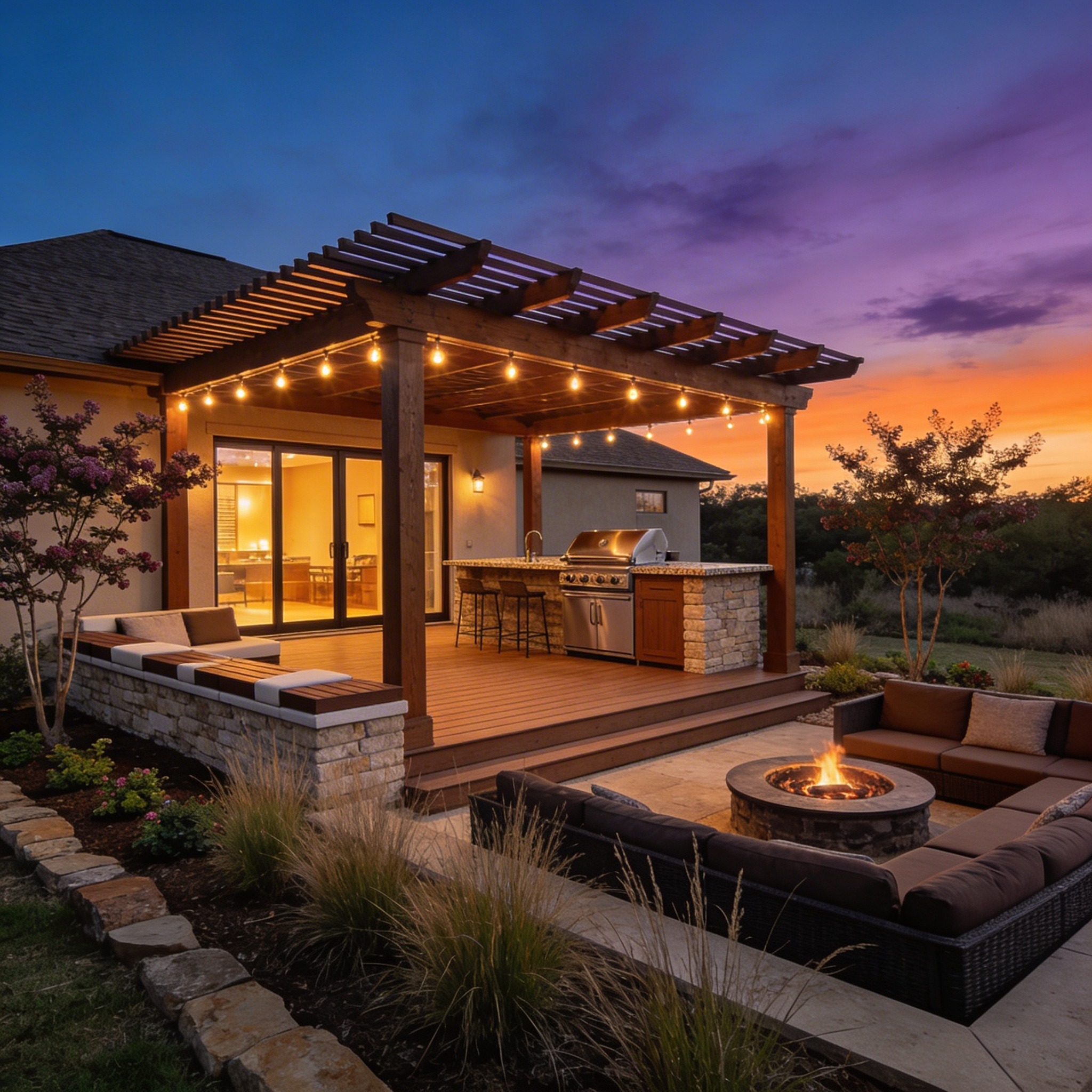
Why Outdoor Living Matters More in North Texas Than Almost Anywhere Else
North Texans have a complicated relationship with their outdoor spaces. The climate offers genuinely spectacular weather — cool, clear winters, vibrant springs, warm fall evenings — but punishing summers that can make unshaded outdoor spaces unusable from June through September.
The homeowners who crack this code — who design outdoor spaces that are comfortable and functional from March through November — add a room to their home without adding to its footprint. They entertain more, spend more time outside as a family, and almost universally report that their outdoor living space is one of the best investments they’ve ever made in their home.
The ones who don’t crack it end up with beautiful-looking spaces they don’t actually use.
The difference is almost entirely in the planning.
Step 1: Define How You Want to Live Outside
Before you choose a material, draw a layout, or talk to a contractor, spend time answering these questions honestly:
How do you actually spend time outside right now? Morning coffee? Evening dining? Weekend entertaining? Active kids’ play? Knowing this shapes every design decision.
Who uses the space? A couple with no children has very different needs than a family with three kids and a dog. Multi-generational households need to design for different levels of mobility and different preferences simultaneously.
How many people do you realistically entertain at once? The answer to this drives space planning more than almost any other factor. Designing for a party of 10 is very different from designing for a party of 40.
What’s your relationship with cooking outside? A full outdoor kitchen is a major investment — deeply worthwhile for families who love outdoor cooking and entertaining, significantly less so for families who prefer to cook inside and eat outside.
How much maintenance are you willing to commit to? An outdoor space with a wood pergola, real wood decking, a plaster outdoor kitchen, and natural stone requires significantly more maintenance than one built with composite decking, aluminum structure, and sealed concrete. Be honest with yourself before you specify materials.
What’s your real budget — not your aspirational budget? A fully appointed outdoor living space in North Texas — pergola, deck, outdoor kitchen, fire feature, landscaping, and lighting — can run anywhere from $40,000 to $200,000+. Know what you’re working with before you start designing.
Step 2: Understand Your Yard’s Constraints and Opportunities
Great outdoor living design starts with the site, not the Pinterest board. Here’s how to read your yard:
Sun orientation. As we covered in our custom pergola design guide for Fort Worth homeowners, sun orientation is one of the most critical and most overlooked factors in outdoor living design. In North Texas (roughly 32–33 degrees north latitude), the afternoon sun comes from the southwest and west — which means west-facing outdoor spaces bake from noon through sunset in the summer. East-facing spaces get morning sun and afternoon shade. South-facing spaces get the most overhead sun in summer but the most winter warmth. Know your orientation before you design.
Existing structures and transitions. How does the outdoor space connect to the house? Where are the doors? What are the sight lines from inside? The best outdoor spaces feel like a natural extension of the interior — which requires designing the transition intentionally. A sliding glass door that exits onto a deck in full afternoon sun is a transition you’ll avoid. A covered transition that steps down naturally to an outdoor kitchen and seating area is one you’ll use constantly.
Utility locations. Know where your gas, electrical, water, and sewer connections are before you plan outdoor kitchen or plumbing locations. Running a gas line across 40 feet of yard is straightforward; running it under a finished deck after the fact is not.
Drainage. North Texas gets intense rainfall events. Your outdoor living space should be designed so water drains away from the house, not toward it. Grade, drainage channels, and permeable paving options all need to be considered during design.
Privacy. What do you see — and what sees you — from your outdoor space? Neighbors, streets, and adjacent properties all affect how comfortable and usable a space feels. Privacy screening through landscaping, fencing, or structural elements should be designed in, not added as an afterthought.
Step 3: Zone Your Outdoor Space Like a Room
The biggest design error in outdoor living is treating the backyard as one undifferentiated zone. The best outdoor living spaces are organized into distinct zones — just like the rooms of your house — each with a specific function:
The Dining Zone
This is where people gather to eat. It needs a flat, level surface (deck, patio, or concrete), proximity to the outdoor kitchen or easy access to the indoor kitchen, adequate shade during the times you’ll use it most, and enough space for a table and chairs that allows comfortable circulation around it. For a family of four with typical entertaining, plan for a minimum 12×16 foot dining zone.
The Lounge / Living Zone
Separate from the dining zone, this is where people relax, have conversations, watch an outdoor TV, or gather around a fire feature. Soft seating — sectionals, club chairs, ottomans — should be oriented toward a focal point (fireplace, fire pit, TV, or view). Plan for at least 14×14 feet for a functional lounge zone.
The Cooking Zone
The outdoor kitchen or cooking station. Its placement should be driven by two things: proximity to the house’s gas and electrical connections (for cost efficiency) and wind patterns (cooking smoke should blow away from the seating areas, not into them). Our detailed outdoor kitchen planning guide for North Texas covers layout, material selection, and budget in depth.
The Transition Zone
The space between your indoor and outdoor living — the steps, the landing, the area just outside the door. Too often designed as an afterthought, this zone sets the tone for the entire outdoor experience. A wide, covered transition that’s protected from direct sun and rain makes moving between inside and outside feel seamless.
The Play / Activity Zone
For families with children, a dedicated active zone — away from the dining and lounge areas — keeps the spaces functional simultaneously. Lawn games, a play structure, or simply an open grass area should be positioned so it’s visible from the adult seating zone.
Step 4: Choose Your Structural Elements First
The permanent, structural elements of your outdoor space define everything else. Get these right and the rest is detail; get them wrong and no amount of furniture or landscaping fixes it.
Decking
The horizontal surface is the foundation of your outdoor living space — literally. In North Texas, composite decking is overwhelmingly the best long-term choice. Products like TimberTech by AZEK offer 25–50 year warranties, fade and stain resistance, cooler surface temperatures than competing composites, and superior slip resistance — critical for a pool deck or any surface that gets wet. As a certified TimberTech partner, we supply and install these products at contractor pricing throughout the Fort Worth area.
If you’re evaluating wood versus composite, our in-depth post on why North Texas homeowners are switching from wood decks to composite lays out the full case.
Shade Structure
No outdoor living space in North Texas is truly functional without shade. Your options — open pergola, louvered pergola, solid insulated patio cover, or a combination — should be chosen based on your orientation, your budget, and how much weather protection you want. A louvered pergola with motorized slats gives you the most flexibility; a solid insulated patio cover gives you the most reliable shade and rain protection.
Outdoor Kitchen Structure
If an outdoor kitchen is in your plans, the structural decisions (BBQ island configuration, countertop material, appliance selection) should happen during the design phase — before anything is built. Retrofitting an outdoor kitchen into a finished deck and pergola is significantly more expensive than integrating it from the start.
Step 5: Light It Like You Mean It
Outdoor lighting is the single most underinvested element in North Texas outdoor living spaces, and it has an outsized impact on how much you actually use the space. A beautifully designed outdoor room that’s poorly lit feels uninviting after dark — and in North Texas, the evenings from March through November are some of the most pleasant outdoor hours of the entire day.
Lighting Zones to Plan For
Task lighting at the grill, prep area, and steps — functional, bright, positioned to illuminate work surfaces without creating glare in the seating areas.
Ambient lighting throughout the pergola or patio cover — overhead fixtures, string lights, or LED tape light along beam lines. This is the primary source of mood and atmosphere.
Accent lighting for landscaping, architectural features, and focal points — low-voltage landscape lighting that makes the space feel three-dimensional after dark.
Step and path lighting — small, low-profile fixtures that illuminate transitions between levels and prevent trips and falls.
All outdoor lighting should be on separate circuits with dimmer controls — ideally integrated into a smart lighting system that you can control from your phone or a keypad inside the house.
Step 6: Integrate Landscaping as a Design Element, Not an Afterthought
The relationship between hardscape (deck, patio, pergola) and softscape (planting beds, lawn, trees) determines how your outdoor space feels — whether it reads as a harsh, exposed structure or as a warm, integrated environment.
For North Texas, the most successful outdoor living landscapes:
Use native and adapted plants. Texas natives and adapted plants — including Texas sage, ornamental grasses, crape myrtles, lantana, and agave — thrive in the region’s heat and drought cycles without constant irrigation. They also support local pollinators and require far less maintenance than non-adapted species.
Create screening with plantings. A well-placed row of Nellie R. Stevens hollies, Leyland cypresses, or bamboo (clumping varieties only) can screen a neighboring two-story without requiring a fence or solid wall.
Ground the structure in planting beds. Foundation plantings along the base of your deck or pergola posts visually connect the structure to the ground, making it feel like it belongs there rather than sitting on top of the yard.
Plan for mature size. Plants in a freshly landscaped backyard look thin and sparse for the first 2–3 years. Design for what the space will look like when plants reach 70% of their mature size, not for how they look the day they’re installed.
Budgeting Your Complete Outdoor Living Space
Here’s a realistic framework for budgeting a complete outdoor living space in North Texas:
| Component | Typical Cost Range |
|---|---|
| Composite decking (400 sq ft) | $15,000–$30,000 |
| Custom pergola (20×20) | $15,000–$40,000 |
| Outdoor kitchen (mid-range) | $20,000–$45,000 |
| Fire feature (gas fireplace or pit) | $5,000–$18,000 |
| Outdoor lighting system | $3,000–$10,000 |
| Landscaping and irrigation | $8,000–$25,000 |
| Concrete / paver patio areas | $6,000–$18,000 |
| Design and project management | $3,000–$10,000 |
A complete, well-appointed outdoor living space in North Texas — composite deck, custom pergola, outdoor kitchen, fire feature, lighting, and landscaping — typically runs $70,000 to $180,000 depending on size and specification level. Entry-level projects focused on a deck and basic shade structure can be done for $30,000–$50,000. Luxury outdoor rooms with full kitchens, louvered pergolas, custom fireplaces, and high-end landscaping exceed $200,000.
To see completed outdoor living projects throughout the Fort Worth and Azle area, visit our project gallery.
Ready to start planning? Contact Lawrence Construction Services at (817) 612-7010 — we design and build complete outdoor living spaces throughout Fort Worth, Azle, and the surrounding North Texas area.
8 Frequently Asked Questions About Outdoor Living Spaces in North Texas
How much does a complete outdoor living space cost in Fort Worth, TX?
A complete outdoor living space in Fort Worth — including a composite deck, custom pergola, outdoor kitchen, fire feature, lighting, and landscaping — typically costs between $70,000 and $180,000 depending on size, material selection, and feature level. Entry-level projects focused on a deck and shade structure start around $25,000–$45,000. Mid-range complete projects run $70,000–$120,000. High-end outdoor rooms with luxury finishes, louvered pergola systems, and full outdoor kitchens range from $130,000 to $200,000+. These ranges reflect installed costs in the North Texas market in 2025–2026.
What outdoor living features add the most value to a home in Texas?
In North Texas, covered outdoor living space consistently adds the most resale value of any outdoor feature — specifically a well-built, attached covered patio or pergola that makes the backyard usable year-round. Outdoor kitchens rank second, particularly in markets where outdoor entertaining is a significant part of the lifestyle. Composite decking outperforms wood decking in resale value because of its low-maintenance, long-warranty profile. Fire features, outdoor lighting, and high-quality landscaping all contribute positively, though returns vary more by neighborhood and buyer demographic.
How do I keep my outdoor living space cool in the Texas summer?
A combination of strategies is most effective for North Texas summers. Structural shade — a solid patio cover or louvered pergola — is the foundation. Ceiling fans rated for outdoor wet or damp locations (minimum 52-inch blade span for larger spaces) create significant perceived cooling through airflow. Misting systems lower ambient temperature meaningfully in drier conditions. Thoughtful orientation — avoiding west-facing exposure or mitigating it with shade sails or fast-growing screening plants — makes a structural difference. Light-colored decking and patio surfaces reflect rather than absorb heat, keeping the surface temperature more comfortable underfoot.
What is the best decking material for an outdoor living space in North Texas?
Composite decking — specifically premium brands like TimberTech by AZEK — is the best overall choice for North Texas outdoor living spaces. Composite handles UV, heat, moisture, and hail significantly better than natural wood. TimberTech products run up to 30 degrees cooler than competing composites and carry 25–50 year warranties. Natural wood requires annual sealing or staining in North Texas’s UV environment and is vulnerable to the moisture cycling that accompanies the region’s clay soils. For most North Texas homeowners, composite’s lower lifetime maintenance cost justifies the higher upfront investment versus wood.
Do I need permits for an outdoor living space in Fort Worth?
Permit requirements depend on the scope of the project. Attached decks and pergolas generally require building permits in Fort Worth and surrounding municipalities. Detached structures over a certain square footage also require permits. Outdoor kitchens with gas connections require a gas permit; electrical additions require an electrical permit. Plumbing connections for outdoor sinks or refrigerators require a plumbing permit. Working with a contractor who pulls all required permits protects your investment and ensures your homeowner’s insurance covers the structure. Unpermitted structures can complicate home sales and insurance claims.
How do I choose between an outdoor kitchen and a fire feature if I can’t afford both?
This is one of the most common budget prioritization questions in outdoor living planning. The answer depends on how you actually use your outdoor space. If you love outdoor cooking and it’s a central part of how you entertain, start with the outdoor kitchen — it has the higher impact on how you use the space day-to-day. If you prioritize ambiance, evening gatherings, and year-round use in cooler months, a well-designed gas fireplace or fire pit provides enormous value at a lower cost than a full outdoor kitchen. A modular approach — building the deck and structure first with rough-in for a future kitchen, then adding the kitchen in a second phase — is a practical alternative that keeps the initial project cost manageable.
What is the best time of year to build an outdoor living space in North Texas?
Fall and early winter — October through February — are generally the best times to build outdoor living spaces in North Texas. Contractor availability tends to be better during the off-season, material lead times are typically shorter, and the weather is more predictable for poured concrete and finish work than the spring and summer storm season. Beginning the process in late summer or early fall means your space can be completed and ready to use for the following spring season. Spring builds are popular but face longer contractor queues and weather delays during North Texas’s active storm season.
How do I find a reliable outdoor living contractor in Fort Worth?
Look for a contractor who designs complete outdoor living spaces — not just one element (decks only, or pergolas only). The most successful projects are designed holistically, with all elements coordinated from the start. Ask for references from completed projects similar in scope and budget to yours, and actually visit or contact those references. Verify the contractor is properly licensed and carries adequate general liability and workers’ compensation insurance. Ask specifically about their experience with North Texas soil and climate conditions. A contractor who pulls all required permits, provides a detailed line-item estimate, and communicates transparently throughout the project is worth more than the lowest bid.
Lawrence Construction Services designs and builds complete outdoor living spaces — decks, pergolas, outdoor kitchens, and custom features — throughout Fort Worth, Azle, and the surrounding Tarrant County area. Call (817) 612-7010 or contact us online to start planning your outdoor space.