If you’ve been scrolling through real estate listings in Azle, Weatherford, or anywhere in the Fort Worth area lately, you’ve probably noticed something: barndominiums are everywhere — and for good reason. What started as a niche rural building trend has exploded into one of the most searched construction topics in all of Texas, and North Texas homeowners are leading the charge.
But what does it actually cost to build one? What should you expect from the process? And how do you know if a barndominium is the right fit for your land, your lifestyle, and your budget?
This guide breaks down everything a North Texas homeowner needs to know before breaking ground — from realistic cost ranges to what separates a well-built barndominium from one that’ll give you headaches for years.
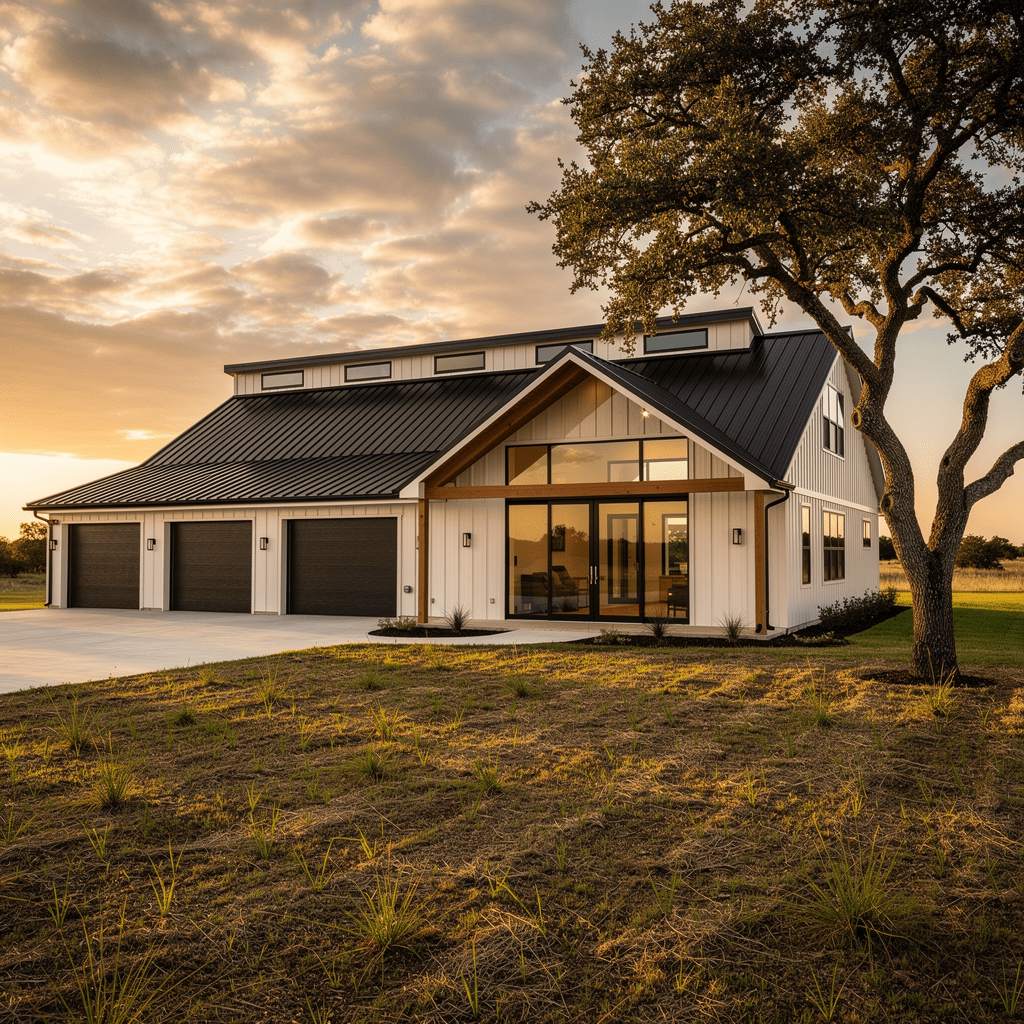
What Is a Barndominium?
A barndominium (or “barndo,” as they’re commonly called in Texas) is a residential structure built on a steel post-frame or metal building shell, finished on the inside to function as a full-time home. The name is a portmanteau of “barn” and “condominium,” but don’t let that fool you — modern barndominiums in North Texas are anything but rustic shacks.
Today’s barndominiums can include:
- Open-concept floor plans with soaring ceilings (16–24 feet is common)
- Chef’s kitchens with custom cabinetry and high-end appliances
- Spa-quality bathrooms with walk-in showers and soaking tubs
- Dedicated workshop or garage bays within the same structure
- Energy-efficient spray foam insulation and modern HVAC systems
- Full smart home technology integration
What makes barndominiums especially appealing to Texas homeowners is the combination of durability, square footage, and cost efficiency — at least when the build is managed correctly.
How Much Does a Barndominium Cost in Texas?
This is the question everyone leads with, and the honest answer is: it depends. But here are the real numbers North Texas homeowners should plan around:
Cost Per Square Foot in the Fort Worth / Tarrant County Area
| Build Stage | Estimated Cost Range (per sq ft) |
|---|---|
| Shell only (steel frame, roof, exterior walls, windows/doors) | $25–$45/sq ft |
| Turnkey, basic finishes (livable but builder-grade) | $100–$150/sq ft |
| Turnkey, mid-range finishes | $150–$200/sq ft |
| Turnkey, custom/luxury finishes | $200–$300+/sq ft |
For context, a 2,000 square foot barndominium with mid-range finishes in the North Texas market will typically run between $300,000 and $400,000 — including the slab foundation, framing, insulation, mechanical systems, and interior finishes.
What Drives the Cost Up or Down?
Several factors significantly impact your final barndominium price in Tarrant County and the surrounding area:
Land and Site Prep If you already own land, you’re ahead. If not, rural land in the Azle, Springtown, and Weatherford corridor has been appreciating steadily. Site prep — including clearing, grading, utilities, and septic (if applicable) — can add $15,000 to $50,000 before a single piece of steel goes up.
Foundation Type Most barndominiums in North Texas are built on a reinforced concrete slab. Given the expansive clay soils common throughout Tarrant County, post-tension slabs are often recommended, which adds cost but is absolutely worth it for long-term stability.
Steel vs. Wood Framing True post-frame metal buildings form the structural shell of most barndominiums. The steel kit itself (columns, roof purlins, metal panels, trim) can range from $20,000 to $80,000+ depending on size, roof pitch, and manufacturer.
Insulation This is where many budget barndominiums go wrong. Metal buildings conduct heat and cold — North Texas summers will cook an under-insulated barndo. Closed-cell spray foam insulation is the gold standard and runs $2–$4 per square foot applied, but it pays for itself quickly in energy savings and comfort.
Interior Finishes This is the biggest variable. A barndominium with LVP flooring, quartz countertops, custom cabinetry, and a walk-in master suite closet will cost significantly more than the same square footage with builder-grade finishes. The good news: you can often phase the finish work over time and prioritize what matters most to you.
Barndominium vs. Traditional Custom Home: How Do They Compare?
One of the most common questions we hear at Lawrence Construction Services: “Is a barndominium actually cheaper than a traditional stick-built custom home?”
The honest answer: sometimes, but not always. Here’s how they compare across the metrics that matter most to North Texas homeowners:
| Factor | Barndominium | Traditional Custom Home |
|---|---|---|
| Cost per sq ft (finished) | $100–$250+ | $150–$300+ |
| Build timeline | 6–12 months | 8–18 months |
| Durability | Excellent (steel frame) | Good (wood frame) |
| Energy efficiency | Excellent (with spray foam) | Good |
| Resale value | Strong in rural TX markets | Strong in suburban markets |
| HOA compatibility | Challenging in many subdivisions | Generally compatible |
| Design flexibility | High (open spans, tall ceilings) | High (traditional layouts) |
| Financing | Available (can be more complex) | Standard mortgage products |
The barndominium’s biggest advantages are speed, open-plan flexibility, and durability in Texas weather conditions (hail, heat, high winds). Traditional custom homes have advantages in established neighborhoods, HOA-governed communities, and conventional financing.
For homeowners deciding between expanding their current property vs. building new, our guide on ADU options and garage conversions for North Texas homeowners covers the alternative if a full custom build isn’t the right fit right now.
What’s Included in a Full Barndominium Build?
When you hire a general contractor for a complete barndominium build in North Texas, here’s what a comprehensive scope typically includes:
Site Work & Foundation
- Soil testing and engineering
- Land clearing and grading
- Underground utilities rough-in
- Reinforced concrete slab (post-tension if required by soils report)
Structural Shell
- Steel post-frame or I-beam construction
- Metal roof and exterior wall panels
- Commercial-grade insulated windows and exterior doors
- Walk doors and overhead garage/shop doors
Rough-In Systems
- Plumbing rough-in (supply and drain lines)
- Electrical rough-in (panel, wiring, boxes)
- HVAC ductwork and equipment installation
- Spray foam or batt insulation
Interior Finish
- Framing of interior partition walls
- Drywall, tape, and texture (or shiplap/wood finishes)
- Flooring (LVP, tile, concrete stain)
- Cabinet installation and countertops
- Plumbing fixtures and trim
- Electrical devices, lighting, and fixtures
- Interior doors and hardware
- Paint
Final Systems & Site
- HVAC startup and balancing
- Plumbing test and final connections
- Electrical panel final and device installation
- Final grade, seeding or sod, driveway (if included)
This is why working with an experienced general contractor who manages all subcontractors is so important — the coordination complexity is significant, and gaps in the schedule or scope can cost you months and thousands of dollars. You can see examples of our completed work in the Lawrence Construction Services project gallery.
Permits and Regulations for Barndominiums in Tarrant County
Barndominiums are not a regulatory gray area in Texas — they require full residential building permits just like any other home. Here’s what North Texas homeowners need to navigate:
In Azle City Limits: Building permits are issued through the City of Azle’s Building Department. You’ll need architectural drawings, a structural engineering letter for the steel frame, and mechanical/plumbing/electrical permits in addition to the main building permit.
In Tarrant County (outside city limits): Tarrant County does not enforce a residential building code for unincorporated areas. However, this does NOT mean you can build without oversight — lenders and insurance companies still require code compliance, and septic systems require permits through the county.
ETJ Areas: If your property is in the Extraterritorial Jurisdiction (ETJ) of a city, that city’s codes may apply even if you’re technically outside city limits. Always verify before you purchase land.
HOAs: This is a critical consideration. Many planned communities in the Fort Worth area prohibit metal exterior structures. If your land is HOA-governed, review the deed restrictions carefully before committing to a barndominium build.
For state-level contractor licensing and code compliance standards, the Texas Department of Licensing and Regulation (TDLR) is the authoritative resource.
Why North Texas Is One of the Best Places to Build a Barndominium
North Texas isn’t just barndominium-friendly — it’s arguably one of the best markets in the country for this style of construction. Here’s why:
Land Availability: The Azle, Weatherford, Springtown, and Mineral Wells corridor still has meaningful acreage available at prices that make 5+ acre tracts accessible for many families.
Climate Suitability: Texas weather is tough on buildings. Steel-framed barndominiums with spray foam insulation handle hail, wind, and temperature extremes exceptionally well — far better than standard wood-frame construction.
Rural Lifestyle with Urban Access: You can build a 3,000 square foot barndominium on 10 acres in Parker County and still be 40 minutes from Fort Worth. That combination is increasingly rare and increasingly valuable.
Texas Values: Barndominiums fit the Texas ethos — functional, durable, expansive, and built for real life (trucks, equipment, animals, and large families welcome).
How to Choose the Right Barndominium Builder in the Fort Worth Area
This decision matters more than almost any other you’ll make in the process. Here’s what to evaluate:
Experience with post-frame construction: Not every general contractor has experience managing steel building projects. Ask specifically how many barndominiums they’ve completed and ask for references from those clients.
Full-service vs. shell-only: Some contractors only erect the steel shell and leave interior finish to you. Others provide complete turnkey construction. Know what you’re hiring before you sign anything.
Local subcontractor network: Your GC’s subcontractors (plumbers, electricians, HVAC) need to be familiar with North Texas code requirements and reliable enough to keep your project on schedule.
Transparent estimating: A detailed line-item estimate protects you. Vague “ballpark” quotes that don’t specify allowances and scope are a red flag.
Communication and project management: A barndominium build involves dozens of moving parts. Ask how the contractor communicates progress, handles change orders, and manages scheduling.
At Lawrence Construction Services, we’ve built custom homes and barndominiums throughout the Fort Worth, Azle, and Tarrant County area. Our custom homes and barndominiums service page outlines our approach, and we’re happy to walk through your vision in a no-pressure consultation.
Ready to explore what your barndominium could look like? Contact us today for a free consultation — we serve the entire Fort Worth and Azle area.
8 Frequently Asked Questions About Building a Barndominium in Texas
How much does it cost to build a barndominium in Texas per square foot?
A finished, turnkey barndominium in Texas costs between $100 and $250+ per square foot, depending on the level of finish, site conditions, and location. Basic builds with standard finishes start around $100–$130 per square foot. Mid-range custom builds with quality finishes typically run $150–$200 per square foot. Luxury barndominiums with premium materials, custom cabinetry, and high-end systems can exceed $250 per square foot. These figures include the steel shell, foundation, insulation, mechanical systems, and interior finishes but generally do not include land purchase or site utility extensions.
Can you get a mortgage to finance a barndominium in Texas?
Yes — barndominiums can be financed in Texas, but the loan options differ from traditional mortgages. USDA Rural Development loans are a common choice for barndominiums on rural properties. Some conventional lenders offer portfolio loans for barndominiums, and construction-to-permanent loans are available through select lenders. The key requirement is that the structure must be built to residential code standards and classified as real property. Working with a lender experienced in barndominium financing will make the process significantly smoother.
How long does it take to build a barndominium in North Texas?
A full turnkey barndominium in the Fort Worth and Tarrant County area typically takes 8 to 14 months from permit approval to move-in, depending on size, complexity, and current contractor availability. The steel shell phase can be completed relatively quickly (2–4 months), but interior finish work — framing, plumbing, electrical, HVAC, drywall, and finish carpentry — takes time regardless of the structural system. Permitting and inspections add additional time in municipalities with active inspection departments.
Are barndominiums a good investment in Texas?
Barndominiums are generally a sound investment in Texas, particularly in rural and semi-rural markets where acreage properties are desirable. Appraisal is one consideration — barndominiums in areas with limited comparable sales can be challenging to appraise at full construction cost. However, as barndominiums have become more common throughout Texas, appraisers have more data to work with. In markets like Parker County, Hood County, and rural Tarrant County, well-built barndominiums hold their value well and often appreciate alongside surrounding land values.
What is the difference between a barndominium and a regular house?
The primary difference is the structural system. A barndominium is built on a steel post-frame or metal building frame rather than traditional wood-stud construction. This allows for wider open spans (fewer interior load-bearing walls), taller ceilings, and a combined living and workspace in a single structure. Barndominiums can look identical to traditional homes on the inside with all the same finishes, fixtures, and amenities — the steel exterior shell is the main differentiator. They’re generally more resistant to fire, pests, and severe weather than wood-frame construction.
Do barndominiums hold up well in Texas weather?
Yes — barndominiums are exceptionally well-suited to Texas weather conditions when properly built. The steel frame is highly resistant to wind damage and hail. Metal roofing systems used in barndominium construction typically carry impact resistance ratings that hold up to North Texas hailstorms far better than asphalt shingles. The key variable is insulation: a barndominium without proper closed-cell spray foam insulation will be uncomfortable in Texas heat. With proper insulation and a quality HVAC system, barndominiums maintain excellent energy efficiency year-round.
Can a barndominium be built in a subdivision or neighborhood with an HOA?
In most cases, no — or at least not without HOA approval. The majority of planned residential communities in the Fort Worth and North Texas area have deed restrictions that prohibit metal exterior structures or require traditional architectural styles. Barndominiums are almost exclusively built in rural or agricultural areas outside HOA jurisdiction. Before purchasing land with the intent to build a barndominium, always review the deed restrictions and any applicable HOA covenants carefully. An attorney familiar with Texas real estate law can help you interpret these documents.
Do I need permits to build a barndominium in Texas?
Yes — a barndominium requires residential building permits regardless of where in Texas you build. Inside city limits, you’ll need a building permit, structural engineering documentation, and separate mechanical, plumbing, and electrical permits. In unincorporated county areas, permit requirements vary by county (Tarrant County does not enforce a residential building code in unincorporated areas, but lenders and insurers still require code compliance). Septic systems always require a permit through the local health authority. Always verify current requirements with your local building department before beginning any work.
Lawrence Construction Services is a custom home and barndominium builder serving Azle, Fort Worth, and the surrounding Tarrant County area. With 30+ years of combined construction experience, we build homes that reflect the craftsmanship and integrity our clients deserve. Call us at (817) 612-7010 or contact us online to start your project.