Building a custom home is one of the most significant decisions a family can make — and in North Texas, it’s also one of the most exciting. The land is here. The space is here. The lifestyle is here. What separates the families who successfully build the home they’ve always imagined from the ones who end up frustrated, over budget, and six months behind schedule? Almost always, it comes down to one thing: knowing the process before it starts.
This guide walks you through every stage of building a custom home in the Fort Worth, Azle, and Tarrant County area — from raw land to move-in day — with the honest, practical detail that most builder websites skip.
Why North Texas Is One of the Best Markets to Build a Custom Home
Before we get into the process, it’s worth understanding why so many families are choosing to build rather than buy in the Fort Worth area right now.
Inventory constraints. The existing home market in Tarrant County and surrounding counties remains competitive. Families who need a specific layout, specific acreage, or a specific location are finding that building gives them options the resale market simply can’t.
Land availability. The corridor stretching from Azle through Springtown, Weatherford, Aledo, and into Parker and Hood counties still offers meaningful acreage at prices that make custom construction viable for a broad range of budgets. You can still find 5–10 acre tracts that are 30–40 minutes from Fort Worth — a combination increasingly rare in growing metros.
Value retention. Custom homes in North Texas — particularly those with quality finishes, energy efficiency, and acreage — have historically held and appreciated their value well. The DFW metro’s sustained population growth continues to underpin real estate values throughout the region.
Lifestyle alignment. North Texans want space, privacy, and the ability to build the way they want to live — large kitchens for entertaining, shops or garages for equipment and hobbies, outdoor living spaces that take advantage of the spring and fall seasons. A production home in a suburban subdivision rarely delivers all of this. A custom build can.
Step 1: Define Your Vision and Budget Before You Do Anything Else
The most common and costly mistake custom home builders make is starting the process backwards — falling in love with a piece of land, or hiring a contractor, before they’ve done the foundational work of defining what they want and what they can afford.
Before you visit a single lot or meet with a single builder, get clear on:
Your non-negotiables. Square footage range. Number of bedrooms and bathrooms. Must-have features (a shop, a pool, a guest suite, a specific kitchen layout). These form the core of your program and drive every design and budget decision.
Your realistic budget — including contingency. A rule of thumb for custom home projects: build in a 10–15% contingency above your expected construction cost. Surprises happen — soil conditions, design changes, material price fluctuations. The families who struggle most are those who start at the absolute top of their budget with no room to move.
Your financing approach. Custom homes are typically financed through construction loans, which work differently from standard mortgages. A construction-to-permanent loan funds the build in draws (payments to the contractor as work progresses) and then converts to a standard mortgage at completion. Talk to a lender experienced in construction financing early — their input will shape what’s realistic for your situation.
Your timeline expectations. In the Fort Worth area, a complete custom home from permit approval to move-in typically takes 10 to 18 months, depending on size and complexity. Add 2–4 months for design and permitting, and you’re looking at a 12–22 month total timeline from the moment you start seriously planning.
Step 2: Find the Right Land
For many families, land selection happens before builder selection — and that’s fine, as long as you evaluate land the way a builder evaluates it, not just the way a buyer would.
What to Check Before Buying Land in North Texas
Soil conditions. This is critical in Tarrant County and Parker County. The expansive clay soils throughout North Texas can move significantly with moisture changes — causing foundation problems that are expensive to address after the fact. A geotechnical (soils) report before purchase gives you the information you need to size the foundation correctly and budget for it accurately.
Utilities and services. Is the property on city water and sewer, or will you need a well and septic system? Electric service at the road, or will you need to extend it? Each of these additions carries real cost — rural utility extensions can run $5,000 to $30,000+ depending on distance.
Flood zone status. North Texas experienced significant flooding in recent years. Check FEMA flood maps and understand whether any portion of your property sits in a floodplain. Building in a floodplain doesn’t disqualify a site, but it adds cost (elevated foundations, flood insurance) and should be factored into your decision.
Access and easements. Verify the property has legal road access. Check for utility easements that may restrict where you can build. Review any deed restrictions or deed covenants — these are legally binding and can prohibit certain building types or land uses regardless of local zoning.
Zoning and setbacks. Know your minimum setbacks from property lines, roads, and water features. These constraints determine how much of the lot is actually buildable — a 5-acre tract with extensive easements, steep topography, and large setbacks may have less usable building area than it appears.
Step 3: Assemble Your Team
A custom home requires a team. The team typically includes:
A general contractor / custom home builder. This is your most important hire. Your GC manages the entire project — subcontractors, scheduling, inspections, material procurement, and quality control. The right GC is your partner and your advocate throughout the build.
An architect or designer. Custom home plans can come from a licensed architect, a residential designer, or a design-build firm that handles both plans and construction. Fully custom architectural plans cost more but give you exactly what you want. Pre-drawn plans with modifications are a cost-efficient alternative for families with a clear vision of their layout needs.
A structural engineer. Required for foundation design in North Texas, particularly given soil conditions. Many builders have a preferred structural engineer they work with regularly.
A lender experienced in construction financing. As noted above, this relationship should start early — before you finalize your land purchase or your builder contract.
Specialty consultants as needed. Depending on your project, you may also engage an interior designer, landscape architect, lighting designer, or technology/smart home consultant.
At Lawrence Construction Services, we offer design-build services for custom homes and barndominiums throughout the Fort Worth and Azle area — meaning we can manage both the design and construction process under one roof. Visit our custom homes and barndominiums service page to learn more about our approach.
Step 4: Design and Plans
Once your land and team are in place, the design phase begins. This is where your vision becomes a buildable document.
Key Design Decisions for North Texas Custom Homes
Orientation. How your home sits on the lot dramatically affects energy efficiency, natural light, and comfort. In North Texas, orienting the long axis of the home east-west (with more windows on the south and fewer on the west) minimizes heat gain from afternoon sun. A good designer will think about this from the start.
Foundation type. Given North Texas soil conditions, post-tension slab foundations engineered to handle expansive clay are typically the best option. Your structural engineer will specify the reinforcement requirements based on the soils report.
Roof design. Hip roofs and gabled roofs both perform well in North Texas. Steep roof pitches shed hail and debris better. Metal roofing has become increasingly popular in the Fort Worth area for its longevity and impact resistance — worth discussing with your designer.
Energy efficiency package. Spray foam insulation in the roof deck, high-performance windows, and a properly sized HVAC system make a significant difference in Texas heat. The upfront cost premium for an energy-efficient envelope pays back in lower utility bills and greater comfort year-round. Our guide on selecting energy-efficient windows and doors for North Texas homes walks through window selection in detail.
Outdoor living integration. The best North Texas custom homes treat outdoor living as a fundamental part of the floor plan — not an afterthought. Covered patios, outdoor kitchens, and the transition between indoor and outdoor space should be designed into the plan from day one, not bolted on at the end. We’ve written a detailed guide on planning a multi-season outdoor kitchen that covers the design considerations worth thinking through during your home’s planning phase.
Step 5: Permitting
Once plans are complete, your contractor submits them to the appropriate jurisdiction for permit review. In the Fort Worth area, this may involve:
- Building permit (the main permit covering structural work)
- Mechanical permit (HVAC systems)
- Plumbing permit
- Electrical permit
- Septic permit (if on private sewer — issued through Tarrant County or the appropriate county health authority)
Plan review and permit issuance timelines vary by municipality. In Azle, Fort Worth, and surrounding cities, plan review for custom residential construction typically takes 3–8 weeks. During busy periods, longer reviews are possible. Your builder should be managing this timeline and following up with the permitting department proactively.
The Texas Department of Licensing and Regulation (TDLR) sets state-level licensing requirements for contractors involved in your build — a useful reference point for verifying credentials.
Step 6: Construction — What Happens and When
Here’s a simplified overview of the construction sequence for a custom home in North Texas:
Site prep and foundation (Weeks 1–8) Clear and grade the site, set temporary utilities, excavate for footings, install underground plumbing, form and pour the post-tension slab, and tension the cables after cure.
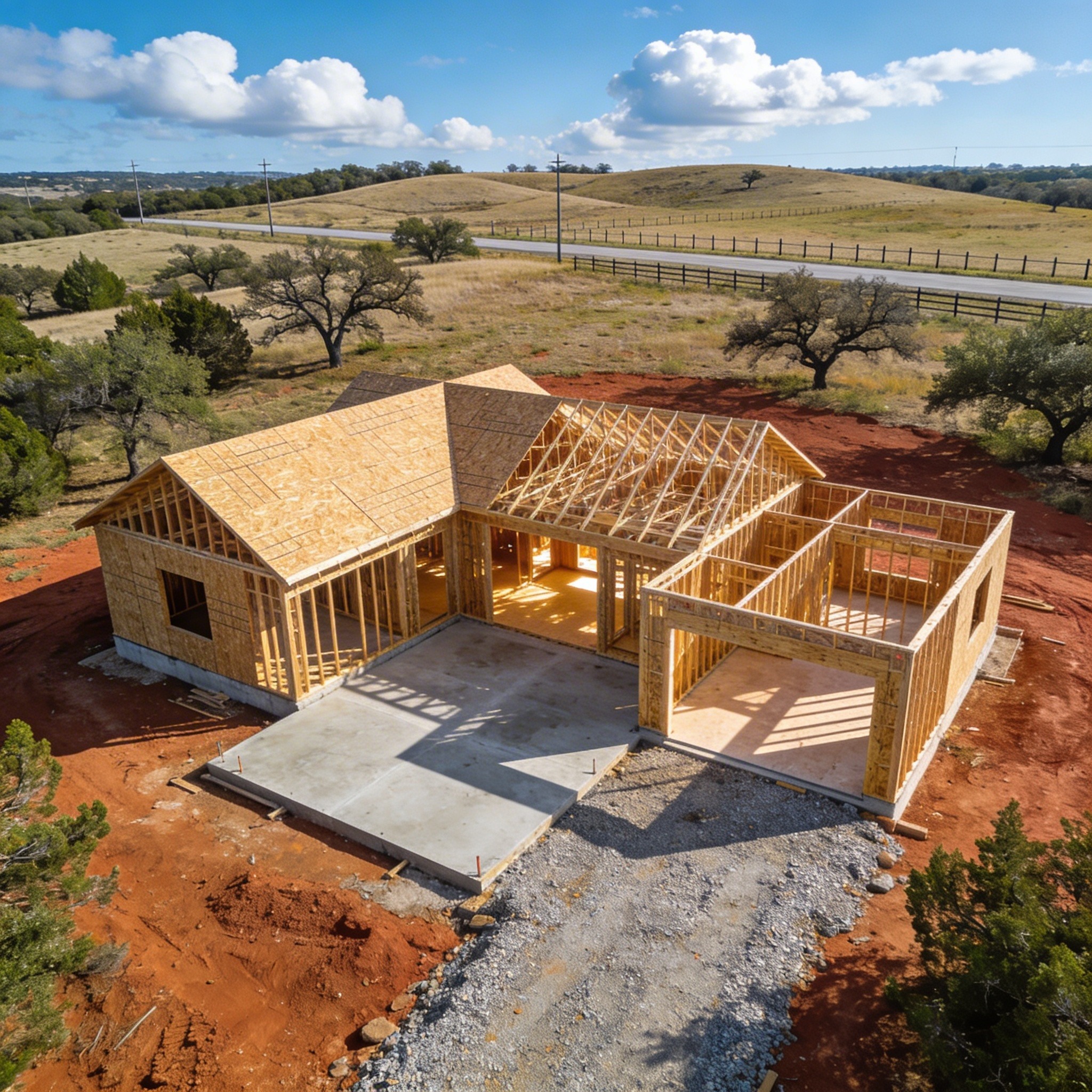
Framing (Weeks 6–14) Erect wall framing, roof framing, sheathing, and housewrap. Install windows and exterior doors. This phase transforms the site — suddenly it looks like a house.
Rough-in systems (Weeks 10–18) Plumbing, electrical, HVAC ductwork, and any low-voltage systems (smart home, audio, security) are all roughed in before walls close. This phase requires careful coordination between trades and multiple inspections.
Insulation and drywall (Weeks 16–22) Insulation is installed and inspected, then drywall is hung, taped, floated, and textured. This phase significantly impacts your construction timeline — good drywall crews are in high demand in North Texas.
Interior finish (Weeks 20–36+) Cabinets, countertops, tile, flooring, interior doors and trim, paint, plumbing fixtures, lighting fixtures, and hardware are all installed during this phase. This is the longest and most labor-intensive phase, and the one where material lead times matter most. Custom cabinetry, for example, can have 8–14 week lead times.
Exterior finish and site work (Weeks 24–38) Exterior siding, stone or brick, roofing, gutters, exterior painting, driveway, landscaping, and final grading.
Mechanical trim-out and final inspections (Weeks 34–42) HVAC startup, plumbing trim, electrical panel energized and devices installed. Final inspections completed with all trades, certificate of occupancy issued.
What Does a Custom Home Cost in Fort Worth / Tarrant County?
Realistic cost ranges for custom home construction in North Texas:
| Finish Level | Cost Per Sq Ft (Construction) |
|---|---|
| Builder-grade finishes | $150–$190/sq ft |
| Mid-range custom finishes | $190–$250/sq ft |
| High-end custom finishes | $250–$350+/sq ft |
A 2,500 sq ft custom home with mid-range finishes in the Azle / Fort Worth area will typically cost $475,000 to $625,000 in construction costs alone — not including land, design fees, permits, or site utility extensions.
These numbers reflect 2025–2026 material and labor costs in the North Texas market. Material costs have stabilized somewhat after the volatility of the post-pandemic period, but labor costs remain elevated given strong construction demand throughout the DFW area.
8 Frequently Asked Questions About Building a Custom Home in North Texas
How much does it cost to build a custom home in the Fort Worth area?
Building a custom home in the Fort Worth and Tarrant County area typically costs between $150 and $350+ per square foot, depending on finish level, site conditions, and complexity. A mid-range 2,500 square foot custom home generally runs $475,000 to $625,000 in construction costs, not including land purchase, design fees, or site utility work. Luxury custom homes with premium finishes, extensive outdoor living spaces, and specialty features can exceed $400 per square foot. Land costs in the Azle and Fort Worth area add $100,000 to $500,000+ depending on acreage and location.
How long does it take to build a custom home in North Texas?
From initial planning through move-in, building a custom home in North Texas typically takes 14 to 22 months. The design and permitting phase runs 3 to 6 months. Active construction — foundation through certificate of occupancy — runs 10 to 18 months depending on size and complexity. Larger or more complex homes with custom features, specialty materials, and extensive outdoor living spaces take longer. Weather delays, inspection backlogs, and material lead times can all extend timelines.
Do I need an architect to build a custom home in Texas?
Texas does not legally require a licensed architect for single-family residential construction under a certain square footage threshold — a residential designer can draw plans for most homes. However, an architect provides value beyond just plan drawing: site analysis, energy efficiency design, structural coordination, and the ability to stamp plans required by some municipalities. For complex homes, homes on challenging sites, or projects requiring engineered structural elements, working with a licensed architect is generally worth the additional cost.
What type of foundation is best for North Texas soil conditions?
Post-tension slab foundations are the most widely recommended foundation type for custom homes in North Texas, specifically because of the region’s expansive clay soils. A post-tension slab uses steel cables tensioned after the concrete cures, creating a foundation that resists the heaving and settling caused by moisture changes in expansive clay. Your foundation design should be based on a geotechnical (soils) report for your specific site — never accept a foundation plan that wasn’t engineered for your actual soil conditions.
What permits are required to build a custom home in Tarrant County?
Inside city limits (Fort Worth, Azle, Saginaw, etc.), you’ll need a building permit, mechanical permit, plumbing permit, and electrical permit at minimum. Plans must be reviewed and approved before construction begins. In unincorporated Tarrant County, municipal building codes don’t apply, but lenders and insurers still require code compliance — and septic systems always require a county health department permit. ETJ (Extraterritorial Jurisdiction) areas may fall under city code requirements even if technically outside city limits.
How do I find a reputable custom home builder in the Fort Worth area?
Start by asking for references from completed projects in the same price range and style as your planned home — and actually call those references. Verify the contractor holds a valid Texas contractor license and carries both general liability and workers’ compensation insurance. Review their contract terms carefully, particularly how change orders are handled, what warranties are provided, and what the payment draw schedule looks like. Local experience matters: a builder familiar with Tarrant County soil conditions, municipal inspection departments, and local subcontractor networks will manage your project more efficiently than one working in the area for the first time.
Can I customize everything in a custom home, or are there limitations?
A true custom home gives you control over virtually every design decision — floor plan, ceiling heights, window placement, material selections, fixture choices, and outdoor living features. The practical limitations are budget, local building codes, and physics. Some features (like extremely large open spans without visible beams) require structural engineering solutions that add cost. HOA deed restrictions may limit exterior material choices, roof colors, or structure heights. Within those constraints, a custom home should be exactly what you design it to be.
Is it cheaper to buy an existing home or build a custom home in North Texas?
In most cases, buying an existing home in the Fort Worth area is less expensive upfront than building a custom home — but the comparison is more nuanced than it appears. An existing home may require significant updates, renovations, or repairs that close the gap. A custom home is built new with modern energy efficiency standards, materials under warranty, and no deferred maintenance. Families who have very specific layout, land, or location requirements often find that building is the only realistic way to get exactly what they need. The right answer depends on your priorities, timeline, and what the market is offering at the time you’re ready to move.
Lawrence Construction Services builds custom homes and barndominiums throughout Fort Worth, Azle, and the surrounding Tarrant County area. With 30+ years of combined construction experience, our team manages your project from initial planning through move-in day. Call (817) 612-7010 or contact us online to schedule a consultation.